Filter by

Virtual Reality as Non-Pharmacological Therapy for Managing Chemotherapy Comp…
Introduction: Cancer patients undergoing chemotherapy often experience physical and psychological side effects from treatment. Virtual Reality (VR) is emerging as a non-pharmacological therapy to alleviate these complaints. Objective: This systematic review evaluates the impact of VR interventions on physical and psychological complaints in cancer patients undergoing chemotherapy. Methods: A sy…
- Edition
- Vol. 10 No. 2 Desember 2024
- ISBN/ISSN
- 2541-0024
- Collation
- Hlm. 187-198
- Series Title
- Jurnal Pendidikan Keperawatan Indonesia, Vol. 10 No. 2 Desember 2024
- Call Number
- (05) 610.5 PRO j
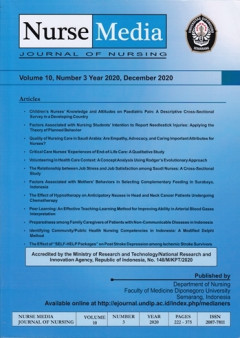
The Effect of Hypnotherapy on Anticipatory Nausea in Head and Neck Cancer Pat…
Background: One of the chemotherapy side effects on head and neck cancer patients is anticipatory nausea. However, the anticipatory nausea problem has not been properly resolved. Nausea might be psychologically reduced by hypnotherapy. There only have been very few studies conducted to examine the effects of hypnotherapy in alleviating anticipatory nausea. Purpose: This study aimed to determin…
- Edition
- Vol. 10 No. 3 December 2020
- ISBN/ISSN
- 2087-7811
- Collation
- Hlm. 317-328
- Series Title
- Nurse Media Journal of Nursing, Vol. 10 No. 3 December 2020
- Call Number
- (05) 610.5 DEP n

Effect of Nei Guan Acupressure Point as Adjuvant Therapy on Highly Emetogenic…
Chemotherapy as a pediatric cancer treatment has nausea and vomiting side effects. Nausea and vomiting in school-age children with cancer can lead to nutritional, emotional, playing, and school function disorders, decreasing the quality of life in children. An adjuvant therapy that can decrease chemotherapy-induced nausea and vomiting is acupressure which is non-invasive and safe. Nei Guan acup…
- Edition
- Vol. 7 No. 1
- ISBN/ISSN
- 2338-5324
- Collation
- Hlm. 67-76
- Series Title
- Jurnal Keperawatan Padjadjaran, Vol. 7 No. 1 April 2019
- Call Number
- (05) 610.5 FAK j
Mucositis Effect on Quality of Life of Hospitalized Children with Cancer Who …
Mucositis is very common in children with cancer who received chemotherapy. Mucositis in children renders other health problems such as pain, eating problems, insomnia, and emotional problems that directly determine children’s quality of life. The purpose of this research was to identify how the effects of mucositis on quality of life in children with cancer who received chemotherapy. The met…
- Edition
- Vol. 7 No. 1
- ISBN/ISSN
- 2338-5324
- Collation
- Hlm. 29-37
- Series Title
- Jurnal Keperawatan Padjadjaran, Vol. 7 No. 1 April 2019
- Call Number
- (05) 610.5 FAK j

IMPLEMENTATION OF SELF-CARE SYMPTOM MANAGEMENT GUIDELINES FOR PATIENTS WITH C…
Introduction: The Self-care Symptom Management (SSM) is educational guidelines with the goal of enhancing patients' self-care abilities to manage the side effects of chemotherapy and quality of life. Objective: The aim of the study was to evaluate self-care guidelines for symptom management of patient with caner receiving chemotherapy to enhance their quality of life (QOL). Methods: The study a…
- Edition
- Vol. 10 Issue 2
- ISBN/ISSN
- 2231-7007
- Collation
- Hlm. 120-130
- Series Title
- The Malaysian Journal of Nursing, October 2018 Vol. 10 Issue 2
- Call Number
- (05) 610.5 LIN t

Cervical Cancer : A Guide for Nurses
- Edition
- -
- ISBN/ISSN
- 978-0-470-06101-5
- Collation
- ix + 237 hlm.
- Series Title
- -
- Call Number
- 616.99 DUN c
- Edition
- -
- ISBN/ISSN
- 978-0-470-06101-5
- Collation
- ix + 237 hlm.
- Series Title
- -
- Call Number
- 616.99 DUN c

The Biology of Cancer, Second Edition
- Edition
- Edisi-2
- ISBN/ISSN
- 978-0-470-05759-9
- Collation
- 204 hlm.
- Series Title
- -
- Call Number
- 616.994 GAB t
- Edition
- Edisi-2
- ISBN/ISSN
- 978-0-470-05759-9
- Collation
- 204 hlm.
- Series Title
- -
- Call Number
- 616.994 GAB t

The New Prescriber : An Integrated Approach to Medical and Non-Medical Prescr…
- Edition
- -
- ISBN/ISSN
- 978-0-4705-1987-5
- Collation
- vii + 509 hlm.
- Series Title
- -
- Call Number
- 615.1 LYM t
- Edition
- -
- ISBN/ISSN
- 978-0-4705-1987-5
- Collation
- vii + 509 hlm.
- Series Title
- -
- Call Number
- 615.1 LYM t
 Computer Science, Information & General Works
  Philosophy & Psychology
  Religion
  Social Sciences
  Language
  Pure Science
  Applied Sciences
  Art & Recreation
  Literature
  History & Geography