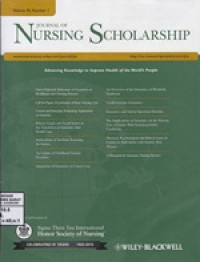
Jurnal
Average Hospital Length of Stay, Nurses’ Work Demands, and Their Health and Job Outcomes
Purpose: To examine the relationship between average hospital length of stay (LOS) of nursing units and work demands perceived by nurses, and between work demands and nurses’ health and job outcomes.
Design: A cross-sectional study using nurse survey data collected in a tertiary university hospital in Seoul, South Korea, in 2013 including 746 staff nurses working on 36 general, oncology, or intensive care units.
Methods: Each unit’s average LOS was categorized as short (1st quartile), medium (2nd and 3rd quartiles), or long (4th quartile). Work demands (i.e., quantitative demands, work pace, and emotional demands), and nurses’ health and job outcomes were measured using the Copenhagen Psychosocial Questionnaire II. Their relationships were examined by multiple linear or logistic regression analyses with multilevel modeling.
Findings: The nurses reported high mean scores of work demands and poor health and job outcomes, compared with other occupations. The nurses working on units with a short or medium (vs. long) LOS perceived higher quantitative and emotional demands, and a higher work pace. Greater quantitative and emotional demands were associated with poor self-rated health, greater sleeping troubles, work–family conflict, stress and burnout, lower job satisfaction, and a greater intent to leave. A higher work pace was also significantly related to greater work–family conflict.
Conclusions: A shorter LOS was associated with higher work demands, and higher work demands were associated with worse nurse outcomes. Thus, excessive work demands should be avoided to prevent nurses’ health and job outcomes from deteriorating.
Clinical Relevance: Nurse managers need to monitor the impacts of reducing LOS on work demands and nurse outcomes and request additional nurses to meet increasing work demands.
Availability
No copy data
Detail Information
- Series Title
-
Journal of Nursing Scholarship, Volume 46, Number 3 2014
- Call Number
-
(05) 610.5 WIL j
- Publisher
- Malden : Wiley-Blackwell., 2014
- Collation
-
Hlm. 199-206
- Language
-
English
- ISBN/ISSN
-
1527-6546
- Classification
-
(05) 610.5 WIL j
- Content Type
-
-
- Media Type
-
-
- Carrier Type
-
-
- Edition
-
Volume 46, Number 3
- Subject(s)
- Specific Detail Info
-
-
- Statement of Responsibility
-
-
Other version/related
No other version available
File Attachment
Comments
You must be logged in to post a comment
 Computer Science, Information & General Works
  Philosophy & Psychology
  Religion
  Social Sciences
  Language
  Pure Science
  Applied Sciences
  Art & Recreation
  Literature
  History & Geography