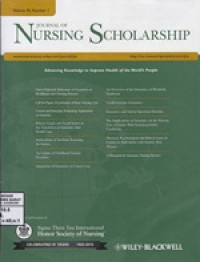
Jurnal
Evaluation of Printed Health Education Materials for Use by Low-Education Families
Purpose: Millions of adults lack adequate reading skills and many written patient education materials do not reflect national guidelines for readability and suitability of materials, resulting in barriers to patients being partners in their own health care. The purpose of this study was to evaluate commonly used printed health materials for readability and suitability for patients with limited general or health literacy skills, while providing easy recommendations to health care providers for how to improve the materials.
Methods: Materials (N = 97) from three clinical areas that represented excellence in nursing care in our organization (stroke, cancer, and maternal-child) were reviewed for a composite reading grade level and a Suitability Assessment of Materials (SAM) score.
Results: Twenty-eight percent of the materials were at a 9th grade or higher reading level, and only 23% were 5th grade or below. The SAM ratings for not suitable, adequate, and superior were 11%, 58%, and 31%, respectively. Few materials were superior on both scales. The SAM scale was easy to use and required little training of reviewers to achieve interrater reliability.
Conclusions: Improving outcomes and reducing health disparities are increasingly important, and patients must be partners in their care for this to occur. One step to increasing patient understanding of written instructions is improving the quality of the materials in the instruction for all patients and their families, especially those with limited literacy skills.
Clinical Relevance: Using materials that are written in a manner that facilitates the uptake and use of patient education content has great potential to improve the ability of patients and families to be partners in care and to improve outcomes, especially for those patients and families with limited general literacy or health literacy skills.
Availability
No copy data
Detail Information
- Series Title
-
Journal of Nursing Scholarship, Volume 46, Number 4 July 2014
- Call Number
-
(05) 610.5 WIL j
- Publisher
- Malden : Wiley-Blackwell., 2014
- Collation
-
Hlm. 218-228
- Language
-
English
- ISBN/ISSN
-
1527-6546
- Classification
-
(05) 610.5 WIL j
- Content Type
-
-
- Media Type
-
-
- Carrier Type
-
-
- Edition
-
Volume 46, Number 4
- Subject(s)
- Specific Detail Info
-
-
- Statement of Responsibility
-
-
Other version/related
No other version available
File Attachment
Comments
You must be logged in to post a comment
 Computer Science, Information & General Works
  Philosophy & Psychology
  Religion
  Social Sciences
  Language
  Pure Science
  Applied Sciences
  Art & Recreation
  Literature
  History & Geography